The Real Spy Tools Used in WWII Resistance Networks
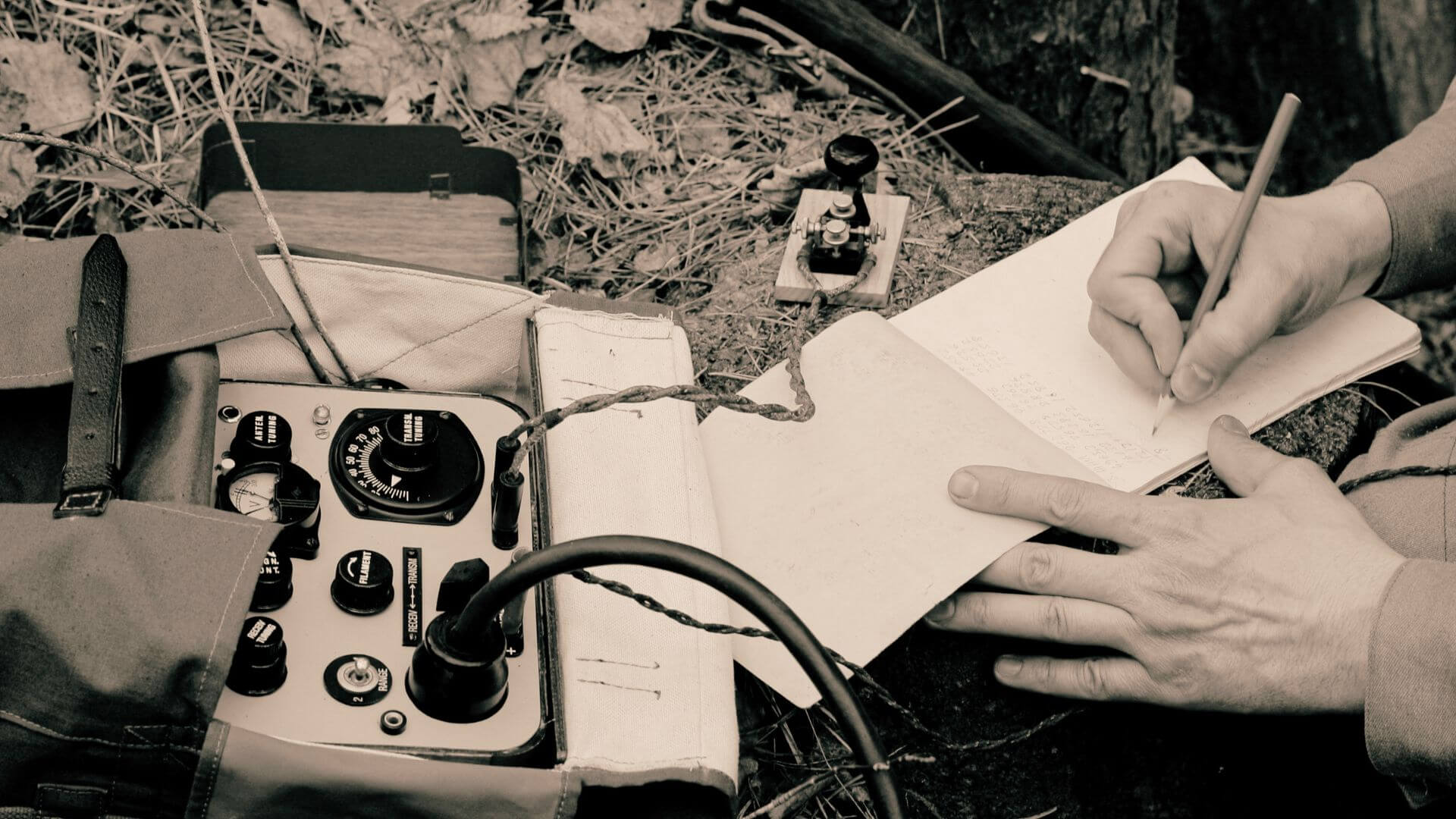
Spy stories often give us the same familiar image.
A hidden radio crackling in the dark.
A coded notebook slipped into a pocket.
A passport that isn’t quite real.
These objects feel cinematic—almost mythical. But when historians study wartime intelligence networks, the truth is far quieter.
The tools used by resistance agents during the Second World War were often small, fragile, and easily overlooked. They weren’t designed for spectacle. They were designed to disappear.
Yet those quiet objects—radios, codebooks, forged identities, and safe houses—made it possible for intelligence networks to survive inside occupied Europe.
Understanding these tools can change how we imagine espionage history—and the historical fiction inspired by it.
If you prefer to watch or listen, you can explore the full historical deep dive in the video below.
The Quiet Reality Behind WWII Spy Tools
Films often portray espionage as a world of dramatic escapes and elaborate gadgets. But most intelligence work during the 1940s depended on discipline rather than spectacle.
A mistyped radio message could expose a network.
A misplaced document could lead investigators to an entire resistance cell.
The objects used by spies were designed for one purpose above all else: invisibility.
They needed to be small enough to hide in ordinary spaces, simple enough to operate quickly, and discreet enough to avoid attention. Many of them looked unremarkable at first glance—because that was precisely the point.
Behind every resistance network was a quiet infrastructure of tools that allowed information to move across borders and battle lines.
Wireless Radios: The Most Dangerous Tool a Spy Could Carry
One of the most vital tools in wartime espionage was also one of the most dangerous: the wireless radio.
Resistance networks relied on portable transmitters to communicate with intelligence headquarters in London. These radios—often hidden in suitcases—allowed agents operating deep inside occupied territory to send information about troop movements, supply routes, and military planning.
But using them came with enormous risk.
German counterintelligence units constantly scanned the airwaves, searching for unauthorized transmissions. Specialized direction-finding equipment could trace a signal back to its source.
Because of this, radio operators were trained to send messages quickly—often in less than twenty minutes, sometimes in as little as ten. The longer a signal remained active, the greater the chance it would be detected.
Historians widely note that wireless operators had some of the shortest survival rates in intelligence work during the war.
And yet they continued transmitting.
One well-known example is Noor Inayat Khan, a British Special Operations Executive (SOE) wireless operator who worked in occupied Paris. After several resistance networks were dismantled by German forces, she became one of the last radio links between Paris and London.
Her work illustrates how a single radio could sustain communication across an entire resistance network.
Codebooks: Turning Messages into Secrets
Even when a message could be transmitted safely, it still needed to remain secure.
This is where codebooks became essential.
Codebooks were small notebooks that converted ordinary language into encrypted messages. A simple sentence like “The shipment arrives tomorrow” might appear as a string of numbers or unrelated words.
Without the correct key, the message would appear meaningless.
Some intelligence networks changed their codes daily. Others used layered encryption systems designed to confuse interceptors.
But codebooks themselves were dangerous objects.
If captured, they could reveal communication methods and expose entire resistance networks. Because of this, agents were often instructed to destroy their codebooks immediately if capture seemed likely.
In many cases, these tools existed only briefly—long enough to transmit critical information before being burned, torn apart, or thrown away.
Living Under an Alias
Another essential tool of espionage was something far less tangible.
A name.
Resistance agents frequently operated under carefully constructed aliases supported by forged documents, false passports, and fabricated biographies.
But carrying paperwork wasn’t enough.
Maintaining an alias meant remembering every detail of a life that didn’t truly exist—where you were supposedly born, where you worked, who might recognize you.
A single hesitation in conversation could be dangerous.
One forgotten detail.
One misplaced accent.
One slip of memory.
The illusion could collapse instantly.
Many intelligence agents later described this part of their work as the most exhausting. They were not simply carrying false documents—they were performing an identity that never paused.
A Common Misconception About Spy Identities
Spy stories often emphasize forged passports and secret papers. But historically, the greater challenge was sustaining the identity in everyday life.
Agents had to become their aliases.
Documents could support the illusion, but conversation, behavior, and confidence were what truly protected it.

Safe Houses: The Hidden Backbone of Resistance Networks
When people imagine espionage locations, they often picture dramatic underground headquarters.
But safe houses during the Second World War were usually far more ordinary.
They were apartments, farmhouses, or small city flats where agents could rest for a night before moving on.
Inside these homes, radios might be hidden beneath floorboards. Documents could be stored inside walls or tucked into everyday household objects.
Sometimes the people who ran safe houses were trained members of resistance networks.
Other times, they were ordinary citizens willing to take enormous risks.
Hosting an agent—even briefly—could bring severe consequences if discovered.
Yet across occupied Europe, thousands of homes quietly became part of the infrastructure that sustained intelligence work.
Behind seemingly ordinary doors, extraordinary acts of courage were taking place.
Why These Details Matter for Historical Fiction
When we look back at wartime espionage, it’s tempting to focus on dramatic moments.
But the deeper history often reveals something different.
A message transmitted quickly.
A code memorized and then destroyed.
A door opened to someone in danger.
For writers and readers of historical fiction, these small details carry enormous storytelling power.
A radio is no longer just equipment—it becomes a source of tension.
A codebook becomes a fragile thread connecting people across borders.
An alias becomes the emotional weight of living between identities.
The real tools of espionage remind us that history is often shaped not only by bold actions—but by quiet decisions made under extraordinary pressure.
Frequently Asked Questions:
What tools did spies use during World War II?
Common espionage tools included wireless radios, codebooks, forged identity documents, and safe houses used to move agents and information safely.
How did WWII spies send messages without being detected?
Many resistance agents used portable radios to transmit coded messages to intelligence headquarters, often limiting transmissions to under twenty minutes to avoid radio detection teams.
What was a codebook in wartime espionage?
A codebook was a small notebook that converted normal language into coded numbers or phrases so intercepted messages would remain unreadable.
Why were wireless radio operators so vulnerable during WWII?
Radio signals could be traced using direction-finding technology, making wireless operators frequent targets of counterintelligence efforts.
Were safe houses really used during World War II?
Yes. Safe houses were ordinary homes used by resistance networks to hide agents, store equipment, and pass messages between cells.
History is often remembered through dramatic turning points.
But when we look closely at wartime intelligence networks, a different picture emerges.
The war moved forward through quiet actions—messages transmitted quickly, documents hidden carefully, identities carried with steady resolve.
The tools themselves were small.
But in the hands of those who used them, they carried enormous responsibility.
If you enjoy exploring the real history behind the novels we love, you’re always welcome to join my newsletter. I share research discoveries, historical insights, and occasional glimpses behind the scenes of the stories I’m writing.