Bargains of Fate by Sharon Virts: What Comes After the Duel
Surviving the worst day of your life isn’t the same as being finished with it.
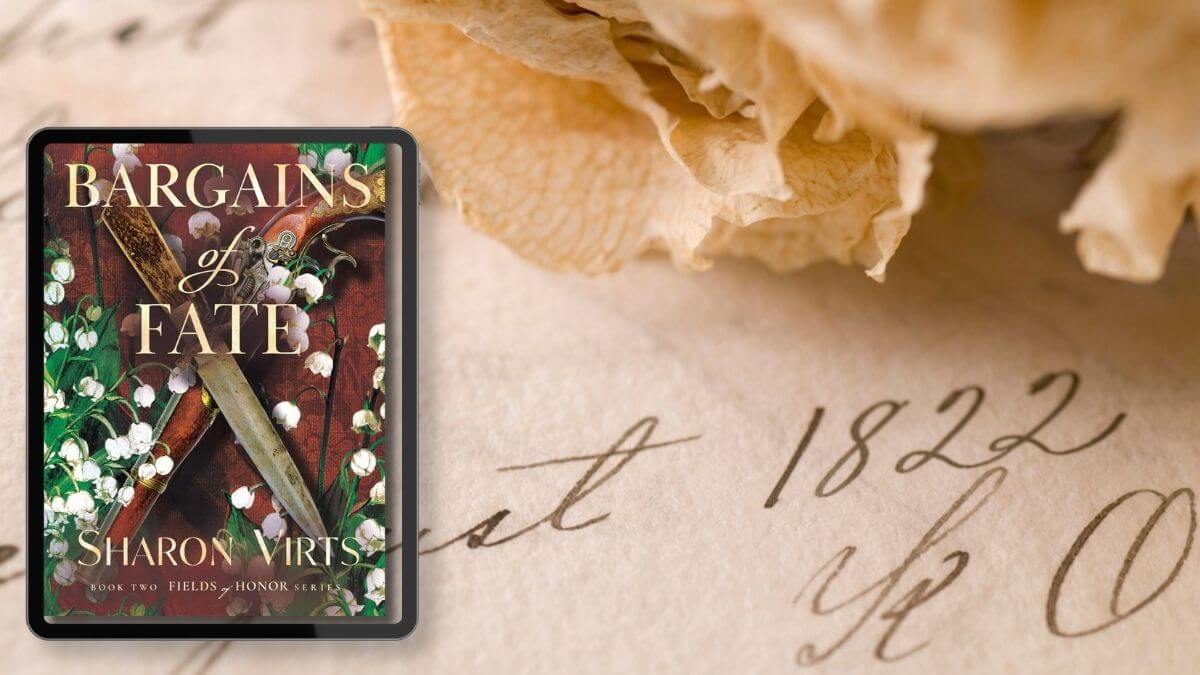
That’s the question running quietly beneath Bargains of Fate, book two in Sharon Virts’s Fields of Honor series. The duel is behind Jack and Lucinda McCarty now. What waits ahead is harder: living with the choices that followed, in a young nation still deciding who it will become.
I recently sat down with Sharon for a second Behind the Book conversation, and I wanted to know how this story found her. The answer begins with an old stone house and a name she couldn’t ignore. And what she uncovered next changed her mind about writing a sequel at all.
A Stone House and a Name She Recognized
Sharon never planned to write a sequel to Masque of Honor. Then, years later, her family began looking at an old stone house built in the 1760s, a property tied to the same Mason family connected to her own historic home.
Curious, she did what historical novelists do. She followed the name.
Thomas Francis Mason, she learned, was an attorney who had defended a man named Dennis McCarty against a murder charge. Dennis was a first cousin of Jack McCarty, the hero of her first novel. And the co-counsel on that trial? John Mason McCarty himself, the real man behind her fictional Jack.
Real history had quietly handed her the next chapter. And that’s where a story she hadn’t planned began to take shape.
If you missed our first conversation, you can revisit the Masque of Honor interview here
Bargains of Fate opens at Christmas 1822 and carries the family through 1825. There’s a murder trial, more than one love story, and, because Jack can’t seem to stay out of trouble, another affair of honor at Bladensburg. How that one ends, Sharon wouldn’t say. She will say the story begins with many threads and gathers into one large, explosive climax.
A Young Nation Left Without a Playbook
For a while, I couldn’t quite see what gave the book its weight. Then Sharon named it.
At its center is the second generation of the American Revolution. She pointed out that John Adams and Thomas Jefferson both died on July 4, 1826. The founders left behind a declaration and a constitution, but no playbook for running a nation. Their children inherited the experiment, along with their own ambitions.
That collision drives the story: personal ambition against doing the right thing when the right thing is hard, unpopular, and written down nowhere. Jack, his brother William, and the men around them each face it, including the early temptation to line one’s own pockets at the public’s expense.
The Women Who Pay the Price
The novel is just as honest about the 1820s for women, when marriages were arranged and a woman without a husband had little say over her own affairs.
Fanny Lee is the character Sharon speaks of with the most empathy. A woman of standing and reputation, she let her guard down in the search for love and paid a price Sharon found deeply unfair, treated little better than an indentured servant. Sharon admits she wanted to shake Fanny a time or two, and still felt compelled to tell her story. Then there’s Sally McCarty, Jack’s spirited mother, who keeps him grounded.
Some of the hardest consequences in this story fall on the women with the fewest choices. Fanny doesn’t appear in the next installment, but she returns in the fourth.
This was the part of our conversation where Sharon’s voice grew warmest, and if you’d like to hear it unfold in her own words, you can watch the full conversation below.
Writing Inside the History
Sharon writes in a historic home of her own, Selma Mansion, and she admits it has a presence. It isn’t haunted in the classic sense, she says, but some days it feels as though something else is helping the words along.
She walks the lanes her characters walked, tours old houses, and sits on the porch at Chestnut Hill imagining what Thomas Francis Mason once saw. She even visits graveyards to sit and talk with the people who lived there. What she’s chasing is atmosphere: the quiet that existed before planes and traffic, so readers can slip into that time and place.
Fields of Honor Series Order
If you’re wondering where to begin, here is the order so far:
1. Masque of Honor (Book 1)
2. Bargains of Fate (Book 2)
The series continues beyond Bargains of Fate. Sharon is clear that this book stands on its own: you don’t need to have read Masque of Honor first, and you’ll find a satisfying finish here even if you stop. It’s a relatively happy ending, though not everything lands softly, so expect an ending that feels earned rather than easy.
Frequently Asked Questions
What is Bargains of Fate about?
Bargains of Fate picks up with Jack and Lucinda McCarty after the events of Masque of Honor, from Christmas 1822 to 1825. It follows a murder trial, new loves, and another affair of honor as the next generation tests what it means to do the right thing.
Do I need to read Masque of Honor first?
No. Sharon Virts describes Bargains of Fate as a standalone story with its own satisfying ending, though readers who love Jack and Lucinda will enjoy returning to them.
Is Bargains of Fate based on a true story?
It’s inspired by real events from the American Regency era. The trial at its center draws on the real attorney Thomas Francis Mason, who defended Dennis McCarty, with John Mason McCarty, the real-life inspiration for Jack, as co-counsel.
What stayed with me most is how Sharon describes the center of the book: living with the decisions we make. Jack and Lucinda strike a bargain with Fanny. Fanny strikes one with them. Dennis has to make one with himself. Fate throws plenty in our way, she says, but it’s the deals we make and the choices that follow that shape where we end up.
She calls the story surprisingly modern, and perhaps that’s why it lingers. We’re all still making our bargains, still learning to forgive ourselves, still deciding what the past gets to decide for us.
Not perfect. Not predictable. But real enough to resonate.
If you love stories where history lives in the quiet consequences, I’d love to have you along.