Masque of Honor by Sharon Virts: The Duel Behind the Story
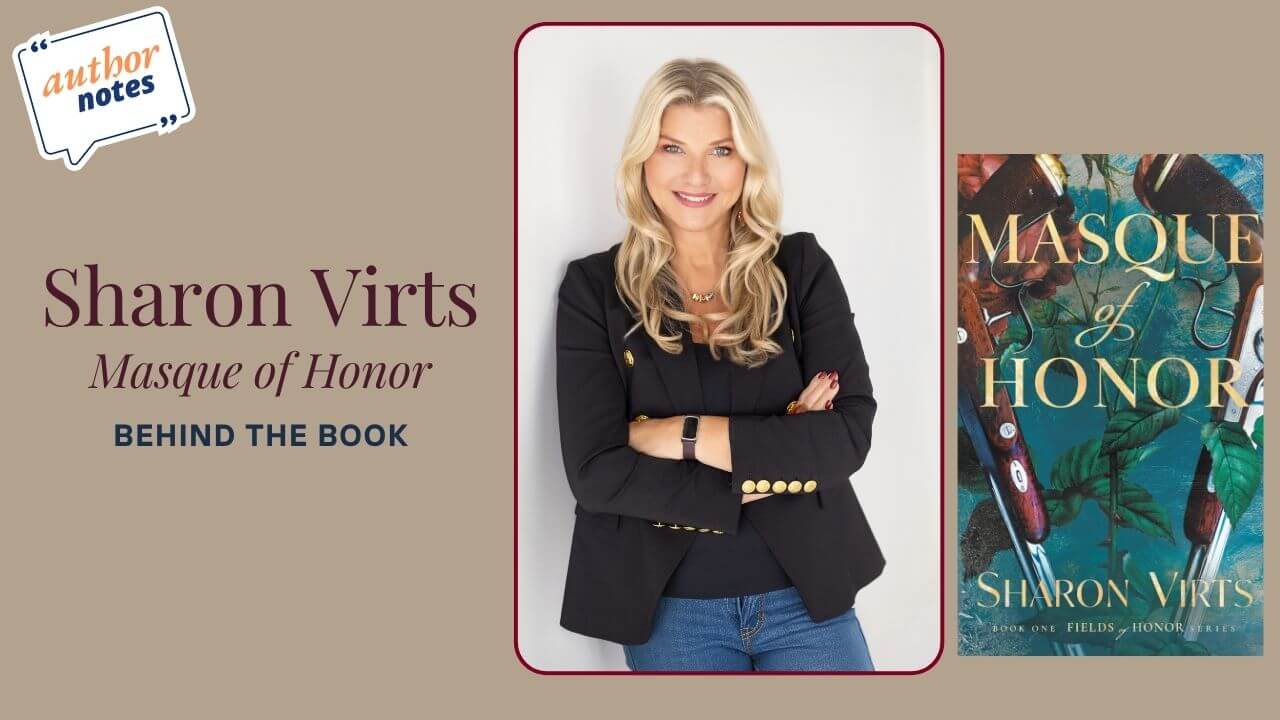
Some stories find their author before their author finds them.
That's true of Masque of Honor. It began not with a plot or a character, but with a falling-down house two and a half miles from where its author grew up — and a Facebook post asking a question nobody could quite answer: does anyone know what this place is?
For historical fiction author Sharon Virts, the answer led somewhere she never expected: a 200-year-old family feud, a duel fought at a distance most of us wouldn't cross a room to avoid, and a story about honor, reputation, and forgiveness that feels — in her words — surprisingly modern.
The Story Behind the Story
The house is called Selma. Built by the Mason family in early Virginia, it had fallen into disrepair by the time Sharon saw it online in 2016 — abandoned, slated for demolition by the county, and, as it turned out, only a couple of miles from the neighborhood where she'd grown up. She and her husband tracked down the owner, made a deal, and brought the estate back from the edge of collapse.
Restoring the house meant living inside its history. Sharon learned that Selma had been built by George Mason IV whose, grand-nephew, Armistead Mason, was, according to local legend, a war hero killed in a duel by his own cousin and brother-in-law. The more she researched that duel — and the man on the other side of it, John "Jack" McCarty — the more she realized the story wasn't going to leave her alone.
It took a nudge from a friend, screenwriter Anthony McCarten, to turn research into a manuscript. He heard her telling the story one night and told her, more than once, that she needed to write it. She started outlining in 2018, and what she found along the way surprised her: Armistead, whom local history had cast as the hero, revealed himself through his own letters and correspondence as the story's true antagonist. Jack — the "rogue" of local legend — became the character she fell for.

The Emotional Core
Masque of Honor, the first book in Sharon's Fields of Honor series, follows Jack McCarty from reckless young manhood into something harder-won: accountability. He's only eighteen at the start of the story, still working out who he is, and shaped by two things he can't quite outrun — a temper that gets him into trouble, and a refusal to lose that he mistakes for strength. Sharon describes him as someone who can't tolerate a bully, which sounds admirable until it isn't.
The women around him carry just as much weight. Lucinda, left without an inheritance after her father's death, has reasons of her own for turning down the wealthiest man in the county — reasons that take the whole book to unravel. And Emily, who Sharon says surprised her most in the writing, becomes the story's quiet moral center: the character who forgives fastest because she understands what holding on would cost her.
For all its dueling-field drama, Sharon is clear that this isn't a book about a duel. It's a book about forgiveness — who can offer it, who can't, and what happens to the people who never learn how.
Research & Immersion
What makes Sharon's process distinctive is the question she keeps asking herself: why. Why would a man set duel terms so extreme his opponent might never accept them? Why would a woman with no dowry refuse a marriage proposal everyone expected her to take? The historical record rarely answers those questions outright — no diary survives to explain Jack McCarty's state of mind before he faced Armistead Mason at three paces, muskets nearly touching. So Sharon builds backward from what's documented — letters, newspaper accounts, a descendant's memoir — toward the human reasoning underneath it.
That approach is also what keeps the history honest. The duel itself, and the code of honor that made it feel inevitable to the people living inside it, are drawn directly from the historical record. The emotional interior — what Jack and Armistead were actually thinking as they raised their weapons — is where the novelist's work begins.
If you prefer to watch or listen to our full conversation, you can view the Behind the Book interview below.
What stays with you after talking to Sharon isn't really the duel — it's the house. A place nearly lost, restored by people willing to sit inside its history long enough to hear what it had to say. Masque of Honor grew out of that same instinct: the belief that an old story, looked at closely enough, still has something to teach us about the ones we're living now.
Sharon's Bargains of Fate, the second book in the Fields of Honor series is the topic of our next Behind the Book with Sharon— and if Jack and Armistead's story stayed with you the way it stayed with me, that conversation is one to watch for.
FAQ
Is Masque of Honor based on a true story?
Yes. Masque of Honor is inspired by the real 1819 duel between Armistead Mason and his cousin and brother-in-law, John "Jack" McCarty, in Virginia. Author Sharon Virts researched the historical record — letters, newspaper accounts, and family memoirs — to reconstruct the events and relationships, while building the characters' inner lives through fiction.
What was the real history behind the duel in Masque of Honor?
The duel grew out of Virginia's early-19th-century culture of honor, in which a man's reputation, financial standing, and social status were tied directly to how he responded to public accusations against his character. Armistead Mason and Jack McCarty, related by marriage, fought with muskets at a distance of roughly ten to twelve feet — a detail drawn directly from the historical record.
What are other historical fiction books set in Virginia?
Virginia's layered colonial, Revolutionary, and antebellum history has inspired a wide range of historical fiction. If you're drawn to Masque of Honor's setting, keep an eye on this blog for future Virginia-set reading recommendations — I'll be adding to this list as new posts go up.