What It’s Really Like to Write Two Books at Once
There are seasons in a writer’s life when one story asks for all your attention.
And then there are seasons when more than one story begins tugging at your sleeve.
That is where I’ve found myself lately—moving between the final Hotel Hamilton novel and the early shape of a brand-new historical mystery series. One story is familiar, layered with characters and history I know deeply. The other is still forming, full of questions, secrets, and possibility.
At first glance, writing two books at once might sound like a matter of productivity.
But I’m learning it’s really a matter of listening.
Because sometimes the challenge isn’t doing more.
It’s knowing which story needs to be held close—and which one needs a little room to breathe.
When Two Stories Are Not in the Same Place
The first thing I should probably clarify is that I am not usually writing two books at the exact same stage of the process.
That would be a fast road to creative confusion.
The final Hotel Hamilton novel is much further along. It belongs to a world I have been writing in for several books now. I know the hotel. I know the emotional threads. I know the rhythm of that series and the kinds of questions those stories tend to ask.
The new historical mystery series is in a very different place.
It is still in the outlining and discovery stage, which means I am not only thinking about one book. I am thinking about the larger shape of a six-book closed series.
That changes everything.
A single mystery novel has its own set of demands. But a closed series asks different questions from the very beginning. What belongs in book one? What must wait? Which secrets can be planted quietly now so they will matter later? How much does the reader need to know—and how much should remain hidden?
So while one book is moving closer to publication, the other is more like a large puzzle spread across the table.
And yes, that table currently includes far too many Post-it notes.

The Story That Has Been Waiting the Longest
One of the interesting things about the final Hotel Hamilton novel is that a small piece of its history has been with me for a very long time.
Before the first Hotel Hamilton novel was even written, there was an image I couldn’t quite let go of—a young woman navigating a new life in a new country.
At the time, I didn’t know where she belonged.
I didn’t know her full story.
I only knew there was something there.
That is often how stories begin for me. Not with a complete plot. Not with every chapter mapped out. But with one small historical detail that refuses to fade.
Sometimes the beginning of a novel is less like deciding what to write and more like realizing what has been waiting for you to notice it.
And that is part of what makes this final Hotel Hamilton book feel so meaningful. It is not simply another story in the series. It carries a thread that has been quietly present from the start, even before I fully understood what it would become.
The Natural Rhythm of Moving Between Projects
Writing two books at once does not mean dividing every day into neat halves.
For me, it is much more seasonal than that.
When one manuscript is with my editor, another project may move into the foreground. When editorial notes come back, the manuscript with the nearest publication timeline takes priority again.
One story may need drafting.
Another may need outlining.
One may need research.
Another may need distance.
And sometimes the most useful thing I can do for a book is step away from it long enough to see it clearly again.
That last part can be difficult to explain from the outside because not every writing day looks productive in an obvious way. Some days are full of words. Some days are full of notes. Some days are full of reading, timelines, questions, or simply thinking.
But those thinking days matter.
Especially when a story is still forming.
And that’s where things started to shift.
I began to realize that working between two projects was not only a challenge. Sometimes, it was also a gift.

When One Story Helps Another
There are moments when one story unexpectedly helps me understand another.
A problem I cannot solve directly may loosen while I am working somewhere else. A decision in one book may help me recognize what another book is missing. A character question in one project may sharpen my understanding of theme in the other.
I don’t think this happens because the stories are the same.
It happens because the creative mind does not always work in straight lines.
Sometimes distance gives a story room to speak more clearly.
That does not mean the process is tidy. It is not. There are days when the timelines, characters, research questions, and emotional threads all seem to crowd together.
But there are also those quiet, surprising moments when one fictional world reaches across to another and hands me the answer I didn’t know I was looking for.
The Challenge of Mental Clutter
The hardest part of working on more than one book is not usually the writing itself.
It is the mental clutter.
Each story has its own atmosphere. Its own emotional rhythm. Its own unanswered questions. And when I move too quickly from one project to another, those rhythms can blur.
That is why I need clear separation.
Separate notes.
Separate outlines.
Separate research documents.
Separate spaces, at least as much as possible, for each story to breathe.
I have also learned that I usually need about a week to fully step out of one story world before I can properly step into another. It takes time for one atmosphere to loosen its grip before I can hear the next one clearly.
For a while, I thought that delay meant I was losing momentum.
Now I think it may be part of the work.
Because writing historical fiction asks for a certain kind of immersion. You are not only tracking plot. You are carrying time, place, history, emotional truth, and the quiet inner lives of characters who need to feel real.
That kind of shift cannot always happen instantly.
If you enjoy these behind-the-scenes looks at how historical fiction takes shape, you may also enjoy my post on What Makes a Character Believable in Historical Fiction.
Watch the Behind-the-Scenes Episode
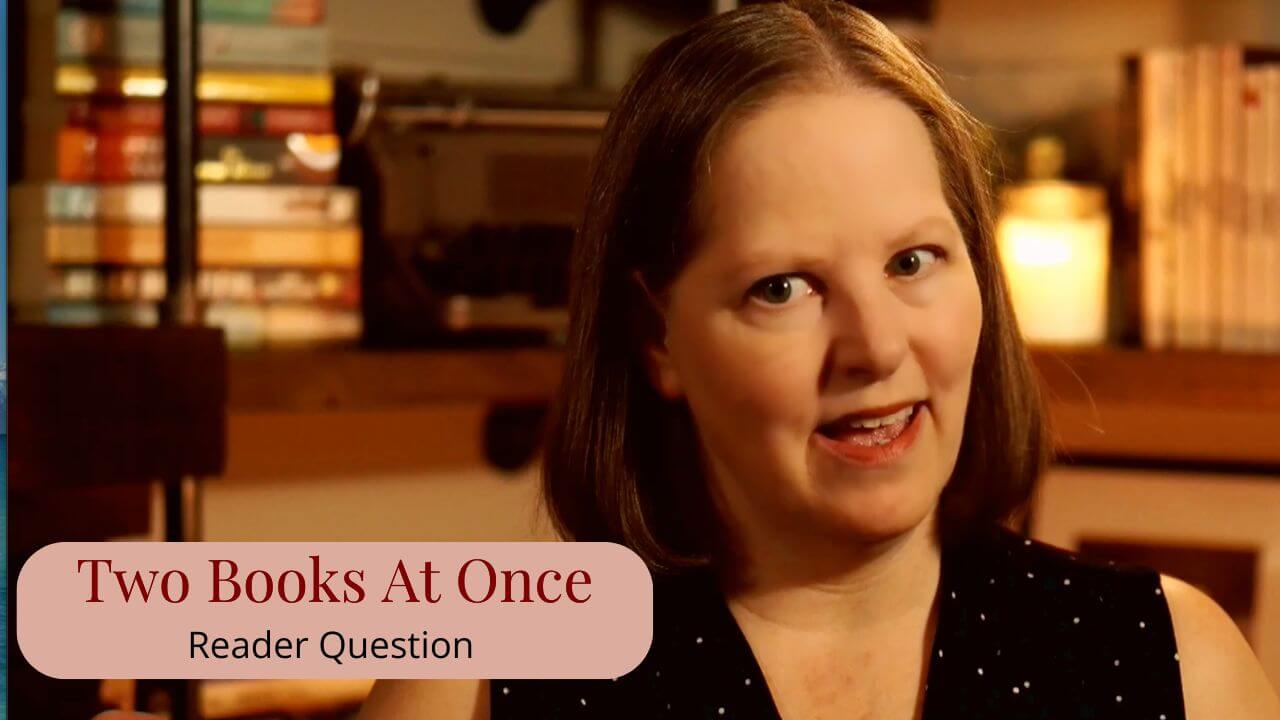
This was the question that inspired the full Author Notes episode: how does a writer actually move between more than one book at a time?
In the video, I share more about what this looks like behind the scenes as I work between the final Hotel Hamilton novel and my new historical mystery series.
What This Season Is Teaching Me
What I am learning is that writing two books at once is not really about doing twice as much at the same time.
At least, not for me.
It is about learning how to carry more than one story with care.
It is about paying attention to deadlines and editorial schedules, yes. But it is also about listening to the stories themselves.
Which one is ready to move forward?
Which one needs more thought?
Which one needs distance?
Which one is quietly tugging at me for a reason I may not understand yet?
Those questions matter because stories rarely arrive fully formed. They reveal themselves slowly, often in pieces, and usually on a timeline that does not feel nearly as efficient as we might like.
But perhaps that is part of why I keep returning to them.
Because somewhere inside the messy middle is the moment when scattered notes begin to connect, a character begins to breathe, and a story that once felt uncertain starts to show me what it wants to become.
FAQ: Writing More Than One Book at Once
Can authors write two books at the same time?
Yes, some authors work on more than one book during the same season, but that does not always mean writing both books at the exact same stage. One book may be in drafting, while another is in outlining, research, editing, or revision.
Is it harder to write a series than a standalone novel?
A series can be more complex because the author needs to think beyond one book. In a closed series especially, certain secrets, character arcs, and emotional threads may need to be planned across multiple books.
How do writers keep different story worlds separate?
Many writers use separate outlines, research files, timelines, character notes, and planning systems. Clear separation helps protect each story’s atmosphere and prevents characters, plots, and historical details from blurring together.
Why does historical fiction require so much planning?
Historical fiction often involves balancing story, character, setting, research, and historical accuracy. Even when the emotional arc is central, the historical world needs to feel believable enough for readers to trust the story.
Some days, writing two books at once feels energizing.
Some days, it feels like too many notes, too many questions, and not nearly enough space in my mind to hold them all.
But every now and then, one story helps another. A problem softens. A missing piece appears. A character who has been quiet finally steps forward.
And those moments remind me that the writing life is not always neat.
But it is often generous in ways I don’t expect.
Not perfect. Not predictable. But real enough to follow.
For more behind-the-scenes reflections on historical fiction, writing life, and the stories that linger long after the last page, you can join me here.